



Are you thinking of moving to Dubai with your children and are you wondering how schools work over there? Or do you simply want to understand how schools work before’investing in a home for your family ?
In a cosmopolitan city where more than 90 % of the population are foreign nationals, the issue of education is vital for thousands of families from all over the world.
The education system in Dubai is largely based on private international schools, which offer a wide variety of curricula (British, American, IB, French, etc.), available to expatriate children from nursery school onwards.
In Dubai, choosing the right school is not just about the curriculum or the budget: it also influences the neighbourhood where you’ll be living, your family’s daily routine, and sometimes even your children’s academic success.
In this article, you will find out:
- A clear overview of the Dubai school system
- The different types of schools and the programmes on offer
- Enrolment procedures and expected costs
- A selection of the best international schools
- And what’s more… the impact of education on the local property market
Ready to Everything you need to know about schools in Dubai ? Let’s go!
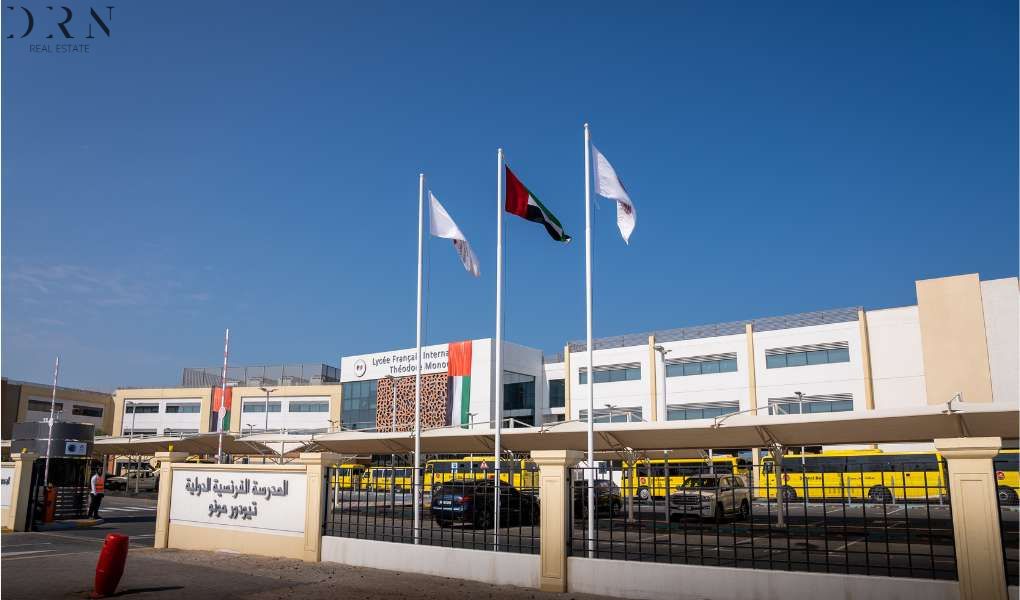
An overview of the school system in Dubai
In Dubai, the education system is very diverse. It welcomes children from all over the world. Every family can choose the school programme that suits them best. There are both state and private schools. State schools are reserved for citizens of the Emirates. The expat families almost always opt for private schools.
Private schools offer a range of systems: British, American, French, Indian and many others besides. Everyone can therefore choose according to one’s language or culture. The school year begins in August or September. It ends in June or July, depending on the programme chosen.
Schools are overseen by the KHDA. This is the body responsible for monitoring the quality of education in Dubai. Standards are often excellent, with schools striving for excellence by emphasising academic achievement and an open-minded approach to the world.
The different types of schools in Dubai
Dubai, a cosmopolitan city in United Arab Emirates, attracts many expatriate families every year. One of the key aspects of this move abroad concerns children’s education. Here are the different types of schools:
1. State schools
State schools in Dubai are run by the government. They are free of charge, but reserved for citizens of the Emirates. Lessons are taught in Arabic. English is taught as a second language.
The curriculum reflects the values and culture of the Emirates. Local history, religion and the Arabic language play a very important role in it. Expatriates cannot enrol their children in these schools. They have no choice: private schools are the only option for them.
These state schools provide a good standard of education. They have been modernised and well-equipped for several years now.
2. Private and international schools
In Dubai, the majority of children attend private schools. They mainly cater for expatriate families. These schools offer a range of international programmes. You can choose based on your language, your country or your values.
Here are the most popular curricula in Dubai: British, American, French, IB (International Baccalaureate), Indian, German, and many more. Lessons are often taught in English. However, some schools also use French, Hindi or German on a day-to-day basis.
Private schools are fee-paying. Fees vary depending on the programme, the level and the school’s reputation. They often offer modern facilities: laboratories, libraries, sports halls, swimming pools, etc.
The quality of teaching is monitored by the KHDA. Every year, it publishes a report on each school.
3. Community schools (French, Indian, etc.)
Community schools in Dubai are very common. They meet the needs of families of all nationalities. For example, the French school follows the French curriculum. Lessons are taught in French, with English used as a supplementary language.
Indian schools follow the CBSE or ICSE curriculum. They teach in English, with subjects relating to Indian culture. There are also German, Canadian, Russian and Japanese schools, amongst others. Each community can therefore maintain one’s educational principles.
These schools enable children to stay connected to their culture. They also help return to the country of origin if necessary. They are private and therefore charge fees, just like other international schools. Fees vary depending on the size and reputation of the school.
The main education systems on offer
Schools in Dubai offer a range of international educational programmes to meet the diverse needs of the expatriate community.
1. The British programme
So let’s start with the British programme, which is very popular in Dubai. It is recognised worldwide for its rigour and structure. The school system begins with Key Stage 1, at around the age of 5. Children then progress through several stages until the age of 18.
At around 14–16 years of age, pupils prepare for the GCSE. These are official exams in a range of subjects. After their GCSEs, they can go on to take the A-Levels, aged between 16 and 18. They then choose three or four subjects to study in greater depth.
A-Levels open the doors to the best universities – whether in Europe, the United States, Canada or elsewhere in the world.
There are many British schools in Dubai. Some are among the best in the country. Lessons are taught in English and include sport, science and arts activities. The schools also foster independence, logical thinking and critical thinking.
2. The US programme
The US programme is very widespread in Dubai. It is valued for its flexibility and practical approach. Children start by Nursery, at around the age of 5. They then progress through to Year 12, at around the age of 18.
The curriculum covers a wide range of subjects. Pupils can choose according to their interests and talents. Towards the end of secondary school, they can take AP course. The “Advanced Placement” enable students to explore certain subjects in greater depth.
AP courses are recognised by universities around the world. They strengthen the academic profile of ambitious students. Students also sit exams such as the SAT or the ACT. These exams are required for admission to US universities.
Lessons are taught in English and are often interactive and creative. There is a strong emphasis on projects, teamwork and participation. It’s perfect if your child dreams of’to study in the United States.
3. The International Baccalaureate (IB)
The International Baccalaureate (IB) is a highly regarded programme. It nurtures curious, open-minded pupils who are well prepared for the world. The programme is divided into three stages: primary school (PYP), lower secondary school (MYP) and upper secondary school (DP).
- The PYP Starts from the age of 3. It focuses on discovery, language and creativity.
- The MYP lasts until the age of 16. Pupils study a range of subjects from a holistic perspective.
- The DP (Diploma Programme) This applies to 16- to 18-year-olds. They choose six subjects, three of which are at an advanced level.
The programme also fosters critical thinking, writing and civic engagement. Pupils are required to undertake a personal project and get involved in society. The IB is very demanding but also very comprehensive. It is recognised by universities around the world.
Lessons are taught in English, sometimes in French or in both languages. It is ideal for families who want to provide their children with an education that opens their minds to the world.
4. The French programme
The French programme in Dubai follows the national education system. It is supported by the network AEFE, recognised by France. Children can start as early as nursery school, at the age of 3. They then continue until they take their baccalaureate, at around 17 or 18.
The subjects are the same as in France: French, maths, history, languages, science, PE and more. Teachers are often trained in France. Lessons are taught in French, with a good standard of English.
The French Baccalaureate opens the doors to universities not only in France, but also in Canada, Switzerland, Belgium and elsewhere around the world. This programme reassures French-speaking families and enables them to maintain their sense of belonging. It allows children to maintain a strong connection with French culture.
In Dubai, There are several French schools available. They follow the French school calendar, with a few local adaptations.
5. Other programmes
In Dubai, there are also programmes for other nationalities. This enables families to maintain their cultural and educational traditions.
The Indian programme is very popular. It follows the CBSE or ICSE curricula, taught in English. The subjects are demanding, particularly in science and mathematics. It prepares pupils well for Indian or international universities.
The German programme follows the German system. Lessons are often taught in German, with English introduced from primary school onwards. It emphasises rigour, languages and critical thinking. Pupils can easily go on to study in Germany.
There are also some Russian, Japanese or Canadian schools. Each school follows the official curriculum of its country of origin.
These schools help children to stay connected to their culture of origin. They also make it easier for them to return to their home country if they wish.
Enrolment procedures and admission criteria for schools in Dubai
In Dubai, enrolment is usually carried out directly with the schools. Each school has its own dates, procedures and criteria. It is advisable to start the process early, especially for schools in high demand. Some have waiting lists, which can sometimes be long.
The following documents are frequently requested: passport, residence visa, vaccination record, school reports.
Children sometimes sit an entrance exam or attend an interview. This helps to assess their level, particularly in English and maths. Some schools also require non-refundable registration fee. Then a deposit to reserve the child’s place.
The admission criteria These vary depending on the school and the year group applied for. Sometimes priority is given to siblings or to pupils of certain nationalities. For the lower year groups (nursery, Year 1, etc.), admission is simpler. The higher the year group, the stricter the selection process can be.
We recommend that you visit the school before enrolling your child. You’ll be able to get a feel for the atmosphere, look around the premises and ask any questions you may have.
Tuition fees and financial support in Dubai
In Dubai, Tuition fees vary considerably from one school to another. They depend on the curriculum, the level, and the school’s reputation. For private schools, fees range from 10,000 AED to over 100,000 AED per year. International schools are often more expensive than other schools.
The older a child gets, the higher the costs become. Secondary school generally costs more than nursery school. In addition to the annual fees, some schools charge fees for enrolment, examinations, transport or school uniforms.
Schools are required to publish their fees with the KHDA. This enables families to compare options before making a decision. As for financial support, there is very little available in Dubai. Some schools offer scholarships or discounts for families on a tighter budget.
Sometimes, employers in Dubai cover part of the costs. This is often the case for expatriate families. But it is better to to budget for all costs to avoid any unpleasant surprises.
List of the best international schools in Dubai
Here is a list of the…the most renowned international schools in Dubai : They are renowned for their quality, their results and their facilities.
- GEMS Education (several schools)
- Curricula: British, IB, American
- Very popular, with a number of top-class campuses.
- Examples: GEMS Wellington, GEMS World Academy
- Dubai College
- British programme
- Highly selective, with excellent academic results.
- A strong reputation in the UK and elsewhere.
- Dubai American Academy (DAA)
- American Curriculum + IB
- Very modern, with an excellent standard in science and technology.
- Excellent results in the SAT and the IB.
- Georges Pompidou International French High School (LFIGP)
- French curriculum (AEFE)
- Highly regarded by the French-speaking community.
- Teaching in line with the French system.
- Jumeirah English Speaking School (JESS)
- British curriculum + IB
- A school that has received a very high rating from the KHDA.
- A great atmosphere and an excellent reputation.
- Swiss International Scientific School (SISD)
- IB Programme, bilingual education (French/English or German/English)
- Modern facilities; boarding available.
- Ideal for multilingual families.
- Repton School Dubai
- British curriculum + IB
- Boarding facilities available; a highly prestigious campus.
- A good blend of tradition and innovation.
- Nord Anglia International School Dubai
- British curriculum + IB
- Outstanding in the arts, sciences and extracurricular activities.
- A global network of prestigious schools.
These schools are highly rated by the KHDA, which are often rated «Very Good» or «Excellent».
The impact of education on the property market in Dubai
Education has a significant influence the property market in Dubai. Families often choose where to live based on their children’s school. Here are the main factors to bear in mind:
- Proximity to schools = high demand : Neighbourhoods close to good schools are highly sought-after. This drives up rents and property prices in these areas.
- Neighbourhoods popular with expat families
- Al Barsha (near the Lycée Français, DAA, Nord Anglia)
- Arabian Ranches (near JESS)
- Mirdif (family-friendly, close to several Indian and British schools)
- Dubai Silicon Oasis and Academic City (Indian, British and American schools)
- Jumeirah and Umm Suqeim (high-end international schools)
- Strategic property investment : Buying a property near a good school ensures a quick and long-term let. Families are keen to minimise their children’s journey times to school.
- School transport and safety : Parents prefer to live near the school to avoid long journeys. It’s more convenient on a day-to-day basis, and it attracts a lot of families to the neighbourhood.
- Property values are stable or rising : Properties near highly-rated schools retain their value well over time. This is a real advantage for those looking to invest wisely in Dubai.
Ready to choose the right school for your children in Dubai?
You’ve now reached the end of this comprehensive article on the Dubai school system.
You now know How does the education system work in Dubai?, what types of schools are available, what programmes are on offer, how much an international education costs, and, above all, how these choices affect your day-to-day life… and even the value of your future property.
To put it simply: whether you already live in Dubai or are planning to move there, choosing a suitable school is a key step towards to ensure your children enjoy a stress-free, high-quality education.
And if you’d like to take your plans to move abroad a step further, you might as well to have good support to choose the ideal neighbourhood based on your children’s educational needs.
Our team Dubai Property supports every day French-speaking families in their new home, with complete peace of mind.
→ Get in touch with our team now to receive support with your search for accommodation in Dubai !
Do you have a question? Is there a school you’re thinking of? Let’s have a chat about it!